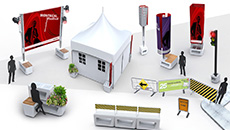
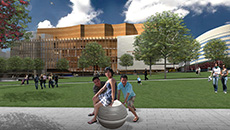
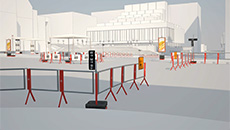
The materials currently used by festivals, such as concrete blocks of various sizes, can cause permanent damage to the outdoor venues where cultural events take place, particularly in the Quartier des Spectacles, which is currently the focus of significant investment.
Organized by the City of Montreal (Design Montreal office and Office of Festivals and Cultural Events), in collaboration with the Montreal International District and the Quartier des Spectacles Partnership, the design competition for the development of removable street furniture for use at festivals is a direct follow-up to the commitments made by the "City" and the partners of the 2007-2017 Action Plan -- Montreal, Cultural Metropolis, which aims to promote excellence in design and architecture by making design competitions standard practice and to affirm Montreal as a UNESCO City of Design. It is also the first competition completed among the "Shuko," challenges launched by Mayor Gérald Tremblay to Montreal designers in September 2008.
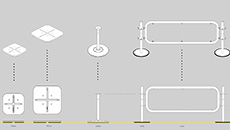
This design competition aims to select a concept for the development and production of removable street furniture for use at festivals. The submitted concepts must address at least the following three elements: anchoring, support, and crowd control. To ensure visual integration, these elements must enable the safe use of public spaces in collaboration with cultural event organizers to preserve and prevent damage to Montreal's festival sites, particularly those in the Quartier des Spectacles. At the conclusion of this competition, the City plans to acquire, in the first year, some 950 anchoring, support, and crowd control systems to be made available to festival organizers.
Through this competition, the City of Montreal seeks to invite candidates to reflect on the complex challenges surrounding these removable street furniture elements and the systems that enable their use. Among other things, these issues involve the protection and preservation of the site, as well as the installation, handling, location, theft, vandalism, transportation, storage, maintenance, and management of the equipment.
The competition consists of two stages. The first stage, which is unpaid, is a pre-selection round: designers are invited to submit an application, which will be reviewed and evaluated by a jury to select the five (5) design firms that will participate in the second stage of the competition. In the second stage, the five (5) competitors will be asked to develop an original concept. At the end of this paid stage, the jury will review the competitors' proposals to select a winner, whose concept will be developed and manufactured by a company selected through a public tender. This company must engage the winner's services for the technical development of the furniture components.
(From specifications document and jury's report)
(Unofficial automated translation)
Evaluation criteria
Context of the project and human factors (30%): 6 points out of 20
The proposed concept must demonstrate a high-quality analysis of the general and complex issues surrounding removable street furniture used at festivals (site management, protection, and maintenance; theft; vandalism; safety, etc.), and must take into account the varied context of use, including human factors. Human factors relate to an understanding of the interactions (transportation, handling, storage, maintenance, installation, etc.) between different users and the functional and formal components of the furniture.
Functional qualities (25%): 5 points out of 20
The functional qualities of an object are those related to the functions and uses for which the object is intended. The functional attributes of removable street furniture intended for use at festivals are specified in the specifications.
Formal qualities (15%): 3 points out of 20
The formal qualities of removable street furniture designed for use at festivals stem from the shape of their constituent elements--whether structural or decorative--as well as from their interrelationships. Formal qualities are context-dependent rather than intrinsic.
Sustainability (15%): 3 points out of 20
The proposed concept must be characterized by a comprehensive approach to environmental criteria. Taking into account life-cycle aspects, such as the choice of raw materials (recycled, renewable), manufacturing (local, efficient), transportation (packaging, stackable), use (durability, adaptability), and end-of-life (repairable, recyclable), helps reduce the product's negative environmental impacts.
Consistency of the design with commercial requirements (15%): 3 points out of 20
Commercial requirements pertain to intellectual property and involve controlling manufacturing and tooling costs in line with procurement objectives. The consistency of the design with these requirements refers to the alignment between the concept proposed by the competitors and the City of Montreal's specifications.
General comments from the jury and deliberations
The jury notes that the issue of removable street furniture for use at festivals is complex and that this is not an "easy" competition. Overall, the jury notes that the competitors showed little innovation and were instead "absorbed" by the task of resolving complex and multiple issues. The jury also questions the relevance of redesigning the Mills barrier if the proposed solutions are not innovative and do not aim to break away from the image of "security and crowd control" associated with this barrier. In their view, a discussion must be initiated regarding the role of this barrier and its inherent contradictions (security and repression versus a festive atmosphere).
The jury is unanimous in its choice of the winning concept and ranks the proposal by the Morelli Designers and Signature Design consortium first. It is the only one that effectively addresses the issue, and its formal qualities are commendable. The proposal by the Arium and Tak Design consortium comes in second place.
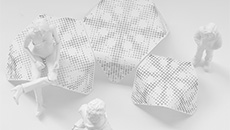
Following their deliberations, the jury decided to award an honorable mention to NIPpaysage for the innovative nature of its proposal. It is also clear that the formal qualities of this proposal impressed the jury members.
(From jury's report)
(Unofficial automated translation)
| Jury | Ruedi Baur, Designer graphique Intégral Ruedi Baur et Associés |
| | Radu Buruiana, Ingénieur-conseil |
| | Renée Daoust, Architecte, designer urbain Associée, Daoust Lestage inc. Architecture & Design urbain |
| | Mario Gagnon, Designer industriel Président, Alto Design Président, Association des designers industriels du Québec |
| | Jean-François Jacques, Designer industriel Météore Design |
| | Tatjana Leblanc, Professeure, École de design industriel, Directrice associée GRAD (Groupe de recherche en aménagement et design) Université de Montréal |
| | Alain Petel, Commissaire Bureau des festivals et des événements culturels, Direction du développement culturel, SDCQMVDE, Ville de Montréal |
| | Pierre Raymond, Directeur de site Les Productions Pierre Raymond inc. |
| | Michael Santella, Designer industriel Professeur en design industriel, Collège Dawson (DIBIS) |
| |
|
| |
|
| |
|
General
Duration of the competition process: 4 months
Call for entries opens: June 8, 2009
End of Phase 1 (selection of finalists): June 25, 2009
End of Phase 2 (selection of the winner): October 5, 2009
Jury meeting: October 7 and 8, 2009
Subsequent stages:
Official inauguration: 2012
Stage 1
June 8, 2009 - Call for entries
June 17, 2009 - Deadline for questions from candidates
June 22, 2009 - Deadline for submitting answers to received and compiled questions
June 25, 2009 - Deadline for submitting applications
June 30, 2009 - Jury recommendations
July 2, 2009 - Public announcement of the 5 finalists advancing to Stage 2
Stage 2
July 7, 2009 - Kickoff meeting with competitors and City representatives
July 9, 2009 - Site visit with competitors and City representatives
September 11, 2009 - Deadline for questions from competitors
September 21, 2009 - Deadline for submitting responses to questions received and compiled
October 5, 2009 - Deadline for submission of proposals
October 7 and 8, 2009 - Jury sessions and interviews with competitors
October 9, 2009 - Jury recommendation
October 19, 2009 - Announcement of the winning project
(From competition brief)
(Unofficial automated translation)
Design Montréal, 09_PDQS_communique_pour_web_FR_080609(2), 2009, Montréal
Design Montréal, Shuko Montréal — Mobilier urbain à l’usage des festivals _ Réalisons Montréal, 2009, Montréal
Design Montréal, 09_RM_Shuko_QdS_annonce_laureat_191009_FINAL, 2009, Montréal
- Rapport du jury (global)
- Rapport du jury (global)
- Règlement
- Cahier des charges
- Règlement